

Western business culture celebrates bold pitches and self-promotion. You walk into meetings ready to showcase achievements and close deals with confidence. But in Japanese business, this approach can backfire spectacularly. Humility, not assertiveness, forms the foundation of successful Japanese partnerships. Understanding why humility matters and how to practice it authentically will transform your ability to build lasting relationships with Japanese partners and unlock opportunities that aggressive tactics would destroy.
Table of Contents
- The Cultural Roots Of Humility In Japanese Business
- How Humility Shapes Communication And Relationships In Japan
- Challenges And Misconceptions Western Professionals Face With Humility In Japan
- Applying Humility To Build Successful Japanese Business Partnerships
- Explore Further Guidance And Services For Japanese Business Success
Key takeaways
| Point | Details |
|---|---|
| Harmony over assertion | Humility supports 'wa' or group harmony, essential for Japanese business success |
| Communication adaptation | Japanese professionals value indirect, modest communication over Western directness |
| Partnership longevity | Demonstrating genuine humility builds trust and reduces conflicts in collaborations |
| Cultural misreading risks | Mistaking humility for weakness damages relationships and derails negotiations |
The cultural roots of humility in Japanese business
Japanese business operates on fundamentally different principles than Western markets. At the core sits 'wa', the concept of harmony that prioritizes group cohesion over individual achievement. Understanding Japanese business etiquette requires recognizing that humility serves as the primary tool for maintaining wa.
When you enter a Japanese business environment, every interaction revolves around preserving harmony. Humility prevents the loss of face, a social catastrophe that can permanently damage relationships and destroy business prospects. Loss of face occurs when someone feels publicly embarrassed or disrespected, creating ripples that affect entire organizations.
Research demonstrates tangible benefits of this approach. Teams emphasizing wa and humility experience 15% fewer disputes and 10% better on-time project completion compared to teams following Western hierarchical models. These aren't minor improvements. They represent the difference between successful partnerships and failed ventures.
The contrast with Western business becomes stark in practice:
- Japanese professionals deflect personal credit to the team
- Decisions emerge through consensus rather than individual authority
- Disagreements surface through subtle suggestions, not direct challenges
- Success belongs to the group, failure to circumstances or shared responsibility
Western assertiveness clashes violently with these expectations. When you promote individual achievements or push for quick decisions, Japanese partners perceive aggression and disrespect. The relationship suffers immediate damage that may prove irreparable. Expert business practice insights reveal that many Western professionals lose opportunities simply by failing to recognize humility's foundational role.
"In Japanese business culture, the nail that sticks up gets hammered down. Humility ensures you contribute to the structure without disrupting the harmony that holds everything together."
This cultural framework didn't emerge randomly. It reflects centuries of social organization where group survival depended on cooperation and conflict avoidance. Modern Japanese business inherited these values and reinforced them through corporate structures that reward team players and marginalize self-promoters.
How humility shapes communication and relationships in Japan
Japanese humility manifests through specific, observable behaviors that differ dramatically from Western communication norms. Humility shows through indirect communication, modesty in self-presentation, and consistent deference to hierarchy. Understanding these patterns helps you navigate conversations and build relationships effectively.
Indirect communication serves as humility's primary vehicle. Japanese professionals rarely state disagreements directly. Instead, they use phrases like "that might be difficult" to signal complete opposition. They pose questions rather than make statements, allowing others to save face while adjusting course. This approach feels maddeningly vague to Western professionals accustomed to explicit feedback.
Deference to seniority and group decisions reflects deep humility. Junior team members wait for senior colleagues to speak first. Decisions require consensus building across multiple levels, a process called nemawashi that happens before formal meetings. Mastering Japanese business etiquette means recognizing that the real work occurs in these informal discussions, not in conference rooms.

Self-promotion violates humility norms completely. Japanese professionals attribute success to their team, their company, or fortunate circumstances. They minimize personal contributions even when individually responsible for breakthroughs. This modesty isn't false humility or fishing for compliments. It represents genuine belief that individual achievement matters less than collective progress.
Key humility behaviors in Japanese business communication:
- Using humble language forms when referring to yourself or your company
- Elevating the status of others through honorific speech
- Pausing frequently to allow others space to contribute
- Acknowledging limitations and seeking guidance rather than projecting expertise
- Accepting criticism gracefully without defensive responses
Western directness creates problems because it prioritizes efficiency over relationship preservation. You might think stating your position clearly helps everyone. Japanese partners interpret this as arrogance and disrespect for the group process. The communication gap widens when Westerners mistake Japanese indirectness for agreement or weakness.
Pro Tip: In meetings with Japanese partners, speak half as much as you normally would and listen twice as carefully. Count to three before responding to any question, giving others time to contribute first. This simple practice signals humility and respect for group dynamics.
Body language reinforces verbal humility. Japanese professionals bow to show respect, with depth and duration indicating relationship status. They avoid direct eye contact, which Western culture values but Japanese culture considers aggressive. Physical distance remains greater than in Western interactions, respecting personal space and social boundaries.
Challenges and misconceptions Western professionals face with humility in Japan
Western professionals struggle with Japanese humility for predictable reasons rooted in cultural conditioning. Your background taught you that confidence wins deals and hesitation signals weakness. Japanese business operates on opposite assumptions, creating friction that derails partnerships before they begin.
The most damaging misconception treats humility as weakness. You watch Japanese colleagues defer decisions, speak tentatively, and avoid claiming credit. Western instincts interpret this as lack of capability or authority. In reality, these behaviors demonstrate sophisticated social intelligence and genuine strength. Misreading humility cues leads to failed negotiations because you misjudge your counterpart's position and intentions.
Self-assertion backfires consistently in Japanese contexts. Western professionals often increase assertiveness when they sense hesitation, thinking they need to lead more forcefully. This escalation destroys trust and confirms Japanese partners' worst fears about working with Westerners. The relationship enters a death spiral where cultural differences amplify rather than resolve.
Practical steps to adapt your approach when working with Japanese partners:
- Study the concept of 'tatemae' versus 'honne', the distinction between public face and private feelings
- Practice self-effacing language that credits others and minimizes your role
- Observe senior Japanese colleagues and mirror their communication patterns
- Develop patience for slow consensus building instead of pushing for quick decisions
- Seek Japanese culture integration guidance from experts with local experience
- Accept that you will make mistakes and respond with genuine humility when corrected
Another challenge involves calibrating humility appropriately. Excessive self-deprecation seems insincere and creates discomfort. Japanese partners recognize when humility becomes performance rather than authentic behavior. You need genuine respect for their culture and willingness to adapt, not theatrical displays of false modesty.
Timing creates additional complications. Western business moves fast, with decisions made in single meetings and deals closed quickly. Japanese business requires extended relationship building before substantive discussions begin. Your impatience to "get down to business" signals disrespect for the process and damages your position.
Pro Tip: Practice mindful self-effacement by genuinely acknowledging your knowledge gaps about Japanese culture and business practices. Frame questions as requests for teaching rather than challenges to explain. This authentic humility builds rapport far more effectively than feigned expertise.
Language barriers compound humility challenges. Even when Japanese partners speak English, cultural concepts don't translate cleanly. Humble speech patterns in Japanese have no direct English equivalents. You might use appropriate words but wrong tone, undermining your message. Professional interpretation and cultural consultation become essential investments, not optional expenses.
Applying humility to build successful Japanese business partnerships
Transforming cultural understanding into practical application requires specific strategies tailored to Japanese business contexts. The following comparison illustrates how humility reshapes fundamental business approaches:
| Aspect | Western Approach | Japanese Approach |
|---|---|---|
| Credit for success | Individual achievement highlighted | Team effort emphasized |
| Decision making | Quick, top-down authority | Slow, consensus-based process |
| Disagreement expression | Direct statement of opposing views | Indirect suggestions and questions |
| Self-presentation | Confidence and expertise projected | Modesty and deference displayed |
| Relationship building | Transactional, goal-focused | Long-term, trust-focused |
Active listening forms the foundation of humility in practice. Japanese partners communicate volumes through subtle cues, pauses, and indirect language. You need to listen not just for words but for underlying meaning and emotional context. This requires full attention, not the half-listening common in Western meetings where you prepare your next point while others speak.
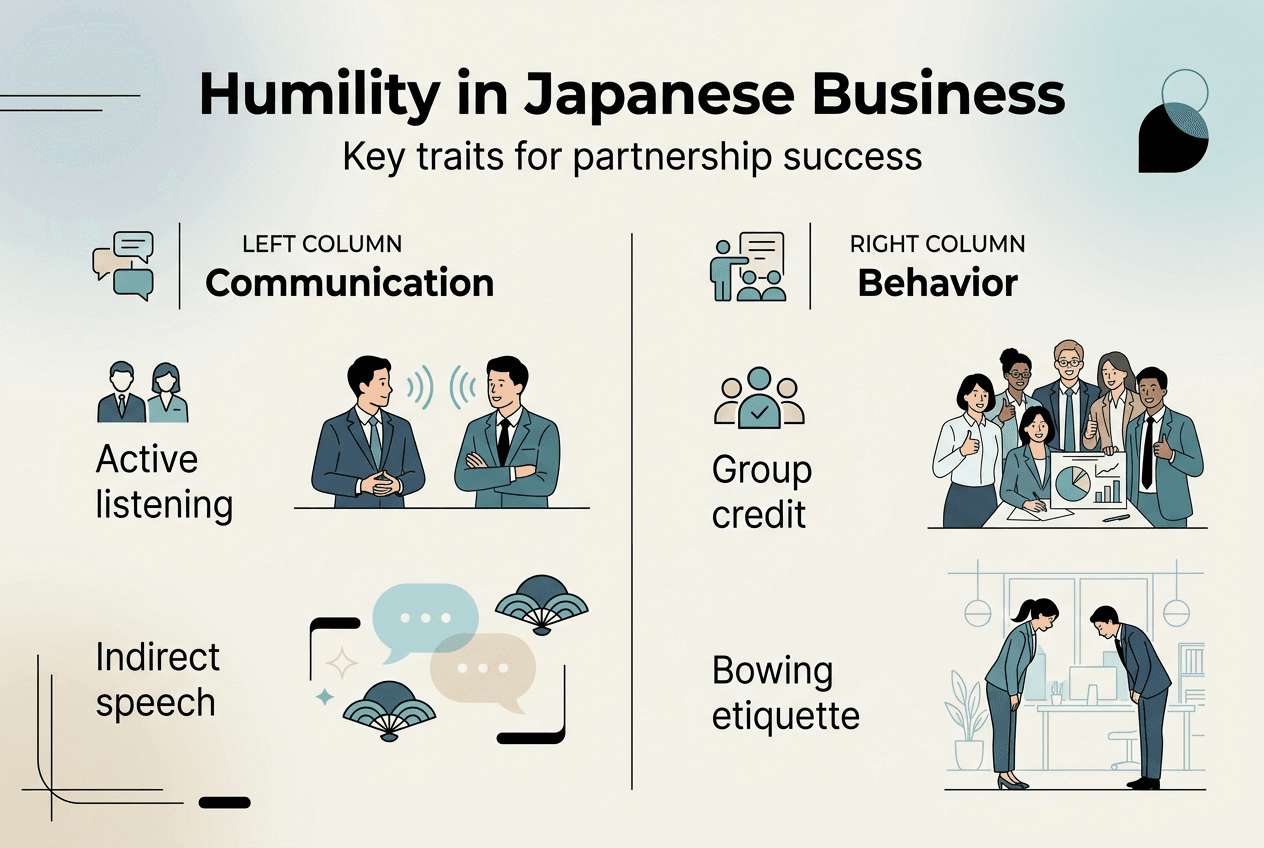
Showing respect extends beyond polite words to genuine deference. Learn proper bowing etiquette and use it consistently. Address people by title and family name unless explicitly invited to use given names. Understand that business cards represent the person, requiring respectful handling with both hands and careful examination before storing them properly.
Avoiding boastfulness demands conscious effort when Western instincts push you to highlight achievements. Teams embracing humility see improved project success and reduced internal conflicts, but only when humility reflects authentic values rather than strategic manipulation.
Dos and don'ts for demonstrating humility with Japanese partners:
- Do attribute success to team effort and fortunate circumstances
- Do ask for guidance and show willingness to learn
- Do wait for senior members to speak before offering opinions
- Don't interrupt or speak over others in meetings
- Don't claim individual credit for collaborative achievements
- Don't push for immediate decisions or rush relationship building
- Don't mistake quiet reflection for disagreement or disengagement
Honorific language deserves special attention because it embodies humility linguistically. Japanese has elaborate systems for elevating others while lowering yourself through verb forms and vocabulary choices. Even basic understanding of these patterns demonstrates respect and commitment to cultural adaptation. Understanding Japanese business etiquette includes learning when and how to use humble and respectful language forms.
Pro Tip: Invest time learning basic Japanese honorific expressions like "itadakimasu" when receiving something and "osewa ni narimasu" when requesting assistance. Using these phrases correctly signals genuine cultural engagement beyond superficial politeness.
Building trust through humility creates partnership longevity that transactional approaches cannot match. Japanese business relationships often span decades, with partners supporting each other through market changes and challenges. This loyalty emerges from demonstrated humility and consistent respect over time. Quick wins matter less than sustainable collaboration.
Practical application also means recognizing when to engage expert business insights rather than learning through costly mistakes. Cultural consultants provide frameworks for specific situations, helping you navigate complex interactions with appropriate humility while maintaining your business objectives.
Explore further guidance and services for Japanese business success
Mastering humility in Japanese business contexts requires more than reading articles. It demands immersive learning, expert guidance, and practical application tailored to your specific business needs. AomoriJPInsider offers comprehensive cultural training and consulting services designed specifically for Western professionals entering Japanese markets.

Our understanding Japanese business etiquette resources provide deep dives into cultural concepts that make or break partnerships. We offer cultural training workshops combining theoretical frameworks with role-playing exercises that build genuine competence. Our Japanese culture integration guide helps you navigate everything from initial meetings to long-term relationship management, ensuring you demonstrate appropriate humility while achieving your business goals.
FAQ
What is the significance of humility in Japanese business culture?
Humility maintains 'wa' or harmony, the foundational principle of Japanese social and business organization. It prevents loss of face and builds trust essential for long-term partnerships. Without demonstrated humility, Western professionals struggle to establish credibility or develop meaningful business relationships in Japan.
How can Western professionals demonstrate humility effectively when working with Japanese partners?
Listen actively without interrupting, attribute success to team efforts rather than individual achievement, and use respectful language consistently. Show patience during consensus-building processes and avoid pushing for quick decisions. Learn basic Japanese honorific expressions and use them appropriately to signal cultural respect.
What are common mistakes Westerners make regarding humility in Japanese business?
Being overly direct or assertive violates humility norms and damages relationships. Many Westerners misread Japanese modesty as weakness or lack of authority, leading to miscalculation. Failing to participate in group consensus processes or showing impatience with decision timelines signals disrespect that undermines partnership potential.